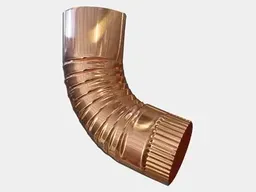
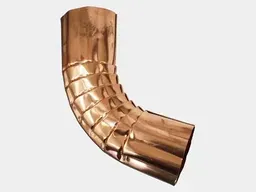
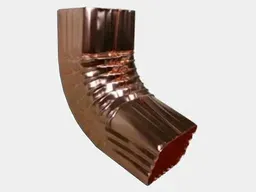
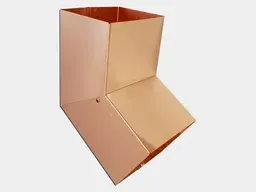
Round Elbows
Choose plain round or round corrugated to match the pipe. The plain round copper listing includes 3-, 4-, 5- and 6-inch sizes; selected round corrugated listings offer a 4-inch profile. Round elbows do not use the A/B distinction.
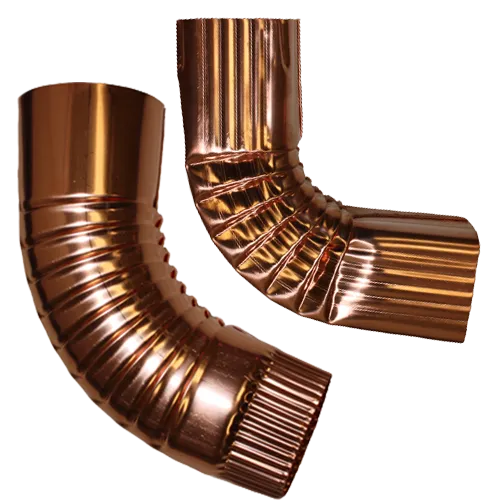
Downspout elbows change the direction of a downspout run. They connect gutter outlets to wall-mounted pipe, create offsets around projections and turn the discharge toward the next part of the drainage system.
K&M Sheet Metal offers round, square and rectangular elbows in smooth and corrugated profiles, with copper, aluminum, steel and specialty material options. Select the elbow by the adjoining downspout’s dimensions and profile, then choose the bend direction, angle and finish.
Choose plain round or round corrugated to match the pipe. The plain round copper listing includes 3-, 4-, 5- and 6-inch sizes; selected round corrugated listings offer a 4-inch profile. Round elbows do not use the A/B distinction.
Plain square and square corrugated elbows follow different pipe profiles. Choose the full width and depth, then the A or B bend direction. A shared nominal size does not make smooth and corrugated connections interchangeable.
The plain round seamless European copper elbow has a smooth curved appearance. Its listed sizes, copper weight and angles differ from the conventional round elbow range.
Round downspouts are often paired with half-round gutters, but the gutter shape alone does not determine the elbow. Match the outlet, downspout and connecting components as a system. Plain round and round corrugated pipe require the appropriate matching profile.
A round fitting can be oriented around the pipe axis to establish the required direction before fastening. Check connection fit, seam position and clearance through the full turn. For a replacement, measure the existing pipe rather than relying on a photograph or the gutter size.
A and B describe the plane of the bend on square or rectangular downspouts. They do not describe the elbow angle. The descriptions below assume the downspout is in its usual installed orientation against the wall; compare the product drawing with your actual pipe orientation.
In a typical installation, an A elbow bends the run toward or away from the building. This is commonly used to connect an outlet beneath an eave to a downspout closer to the wall.
A B elbow bends the run sideways, left or right relative to the building. Check any direction selection on the listing and the position of the connecting ends when planning your layout.
To request help, send a front view and a side view of the connection, with the pipe dimensions and desired water path marked. This is more useful than asking for a “left elbow” without showing the viewing direction.
K&M’s conventional elbow range uses the designations below. A 75-degree elbow is a common selection, but it is not the same fitting as a 90-degree elbow. Check the chosen product for the available angle and size combination.
| Elbow designation | Bend angle |
|---|---|
| #0 | 30° |
| #1 | 45° |
| #2 | 60° |
| #3 | 75° |
| #4 | 90° |
Select the angle from the actual route and available space. A degree designation by itself does not tell you the finished offset: elbow dimensions, connection overlap and any pipe between the bends also affect the layout. Include a dimensioned sketch for unusual turns.
K&M’s plain round seamless copper elbow is listed in 3- and 4-inch sizes, made from 18-ounce copper, with 40-, 72- and 85-degree options. These are product-specific specifications rather than the conventional #0 through #4 angle range.
In this product family, “seamless” describes a smooth appearance with a welded, minimally visible seam. It does not mean the elbow-to-downspout connections disappear. Compare the exact dimensions and angles when replacing an existing fitting.
View the European copper elbowCommon rectangular sizes include 2 × 3, 3 × 4 and 4 × 5 inches, with additional sizes on selected plain-square products or by custom request. Do not assume every size is available in every profile, angle and material.
In a typical gravity-flow assembly, the upstream piece’s reduced or crimped end fits inside the receiving downstream piece. Suitable rivets or screws secure the connection. Some ends need additional crimping, particularly after cutting pipe or when matching another manufacturer’s product. Confirm the fit before final fastening.
Plan for access: Keep the system supported and allow for inspection and cleaning. Joint treatment depends on the installation; sealant is not a substitute for correct overlap, an appropriate fitting or a clear drainage path.
Options across the elbow range include copper, painted aluminum, Kynar-finished steel, Galvalume Plus, zinc, Freedom Gray and lead-coated copper. Availability varies by profile and model. Common specifications include 0.027-inch painted aluminum, 0.032-inch Kynar aluminum, 24-gauge steel and 16-ounce copper, with other thicknesses on selected products.
Confirm the base metal as well as the color. Kynar describes a coating resin brand, not a metal, and a copper-colored painted elbow is different from bare copper. Compare physical samples when matching existing gutters, since weathering, gloss and coating differences can affect appearance.
Explore materials and color chartsAn offset changes the position of the downspout and then returns it to its original direction. A common arrangement uses two elbows and a connecting pipe section to bridge the distance between a gutter outlet and the wall. Similar layouts can route around a ledge or other projection.
K&M can review custom angles for smooth square and plain round elbows. These may use fabricated sections rather than the incremental bends of a conventional elbow. Z-shaped or zigzag offset assemblies are custom-order items requiring larger quantities; contact us to confirm minimums and fabrication options.
Send a dimensioned sketch showing the profile, both connection points, offset distance, available height, material, finish, quantity and desired seam position. Include the delivery location and requested schedule for a quote.

Black

Dark bronze

Musket Brown

Royal brown

Almond

Linen

Low Gloss (30°) White

High Gloss (80°) White
Special Order colors require a minimum purchase of 325 lbs. coil.
London brown

Evergreen
Russet red
Charcoal grey
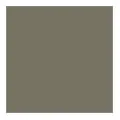
Terra bronze
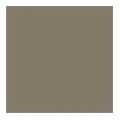
Montana suede
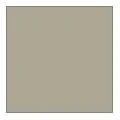
Jefferson tan

Harbor grey
Everest
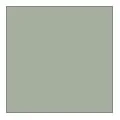
Scottish thistle
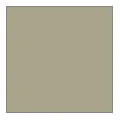
Pebblestone

Victorian grey
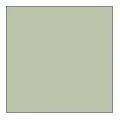
Tuscan olive
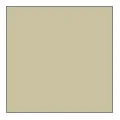
Wicker
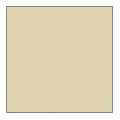
Sandstone
Desert sand
Classic cream
Cameo

White
Aluminum material is supplied by
Mastic.
All colors are available in 0.027″ aluminum, in 11.75″ or 15″ coil.
Special Order colors require a purchase of a 325 lb. coil.
PDF – Mastic 0.027″ Aluminum Color Chart
Mastic does not offer a physical color chart or color chips.

Black

Matte Black
**24 Gauge Steel Only
Dark Bronze
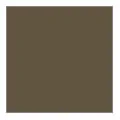
Medium Bronze
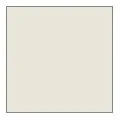
Almond

Bone White
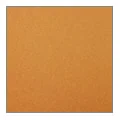
Copper Penny

Charcoal
Special Order colors require a minimum 2000 sqf. purchase for coil. Most colors have a 1 sheet minimum per order. Extra freight charges apply.

Patina Green

Teal

Hemlock Green

Forest Green

Hartford Green

Evergreen

Hunter Green

Arcadia Green

Military Blue

Berkshire Blue

Graphite

Interstate Blue

Slate Blue

Award Blue

Burnished Slate
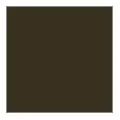
Aged Bronze
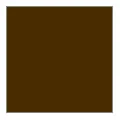
Mansard Brown

Burgundy
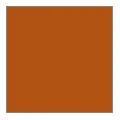
Terra Cotta

Cardinal Red

Colonial Red

Midnight Bronze

Musket Gray
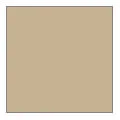
Sierra Tan
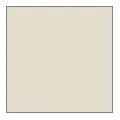
Sandstone

Slate Gray
Cityscape
Granite

Stone White
Anodic Clear
Silversmith
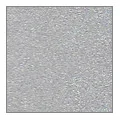
Silver
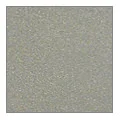
Champagne
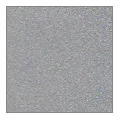
Zinc
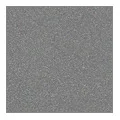
Weathered Zinc
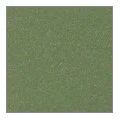
Aged Copper
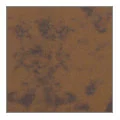
Weathered Steel
Kynar coated material is supplied by
Petersen (Pac-Clad).
Colors are mostly available in 0.032″ and 0.040″ aluminum as well as 24 gauge galvalume (steel).
Some colors are available in 0.050″ and 0.063″ aluminum as well as 22 gauge galvalume.
Material available in sheet or coil format.
Pac Clad Sheets measure 48″ x 120″. No minimum purchase, but fees apply.
Standard coil widths are 20″ and 24″. Coils can be cut to any custom with from 48″ and under. Fees apply. 2000 sqf minimum purchase.
To learn more about Kynar® PVDF coated materials, please
click here.
PDF – PAC CLAD – Kynar Aluminum and Galvalume Steel Color Chart
Color Chart – To obtain a physical color chart or color chips, please visit this link.
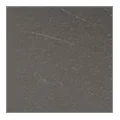
Bonderized Steel
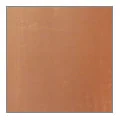
Copper
Freedom Gray
Galvalume Plus
Galvanized Steel
Lead Coated Copper
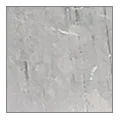
Mill Finish Aluminum
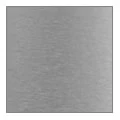
Stainless Steel
Bonderized Steel: Also known as Paint Grip. Offered in 26 gauge G90. 24 gauge available as special order.
Copper is commonly stocked in 3′ x 10′ and 4’x10′ sheets, 11.75″, 15″ 18″, 20″, 24″ (16 oz. or 20 oz.) and 36″ coil (16 oz.). 24 oz. and 32 oz. are available in 3′ x 10′ sheets. Our typical stock is 1/8 to 1/4 hard copper, supplied by Aurubis, Hussey and Revere.
We also stock 1″ x 3/16″ x 12′ bar stock. Other sizes as well as 48 oz. copper are available as special order items.
Freedom Gray is commonly stocked in 3′ x 10′ sheets of 16 oz. and 20 oz. Coils are available as a special order item with a 1000 lb. minimum. Freedom gray is a Tin / Zinc coated copper from Revere Copper.
Galvalume Plus is an Acrylic coated metal, also known as Acrylume. K&M utilizes Acrylume E Plus™ supplied by US Steel.
Galvanized Steel: Offered in 26 gauge G90. 24 gauge available as special order.
Lead Coated Copper is commonly stocked in 3′ x 10′ sheets of 16 oz. and 20 oz. Special order items include 3′ x 8′ sheets and 12″, 15″, 18″, 20″ and 24″ coil stock. A minimum of 1000 lbs. is required for a coil order.
Mill finish Aluminum is commonly stocked in 4′ x 10′ sheets of 0.032″ and 0.040″.
Stainless Steel in normally available in 24 and 26 gauge 4′ x 10′ sheets, 304 alloy 2B finish. Other thickness, and finishes such as #4, #8 and 2D available as special order items.
PDF –
Acrylume E Plus Coated Sheet Steel (Data Sheet)
PDF –
Aluminum – Alcoa (SDS)
PDF –
Copper (ASTM B370 Building Spec Sheet)
PDF –
Copper – Revere (Spec Sheet)
PDF –
Copper – Revere (MSDS)
PDF –
Freedom Gray Copper – Revere (Spec Sheet)
PDF –
Lead Coated Copper (ASTM B101 02 Building Spec Sheet)
PDF –
Stainless Steel – Outokumpu (Data Sheet)
PDF –
Expanded Aluminum Metal Flattened
PDF –
Expanded Copper Metal Flattened
Other colors, materials and thickness may be available upon request. Colors displayed for reference only.
Please click here for a full selection of colors and materials offered.
 FAQs
FAQs
Compare bend directions, angles and profiles before selecting elbows for your gutter system.
An elbow changes the direction of the downspout. It can connect a gutter outlet to a wall-mounted pipe, help route around a projection or turn the discharge toward the next part of the drainage system. Match the elbow to the adjoining pipe and the required route.
For square and rectangular downspouts in their usual orientation against a wall, an A elbow bends toward or away from the building, while a B elbow bends sideways along the wall. A and B identify bend direction, not angle. Compare the drawing with your installation, especially if the pipe is rotated.
Round elbows do not use the A/B distinction. Their round connections allow the bend to be oriented around the pipe axis before fastening. You still need to match the profile, diameter, angle and connection details.
In K&M’s conventional elbow range, #0 is 30 degrees, #1 is 45 degrees, #2 is 60 degrees, #3 is 75 degrees and #4 is 90 degrees. Availability depends on the product. The seamless European copper elbow uses a separate angle range.
A 75-degree elbow is common in K&M’s conventional range, but multiple angles are offered. Do not assume a fitting called a 90 is actually 75 degrees. Select the listed angle that suits the layout and check its dimensions before ordering.
Use the size and profile of the adjoining downspout. Measure the diameter for round pipe or width and depth for rectangular pipe. Smooth and corrugated profiles must be identified separately. Gutter width alone does not determine which elbow will fit.
They may, but matching nominal dimensions does not guarantee a fit. Seams, corrugations and actual connection dimensions can differ. Some installations need additional crimping or an adapter. Send measurements and photos if you are matching an existing system.
K&M describes these as elbows with a smooth appearance and a welded, minimally visible seam. The listed European copper model uses 18-ounce copper, comes in 3- and 4-inch sizes and offers 40-, 72- and 85-degree angles. Check that specific model rather than applying conventional elbow specifications.
A typical offset uses two elbows, often with a straight pipe section between them: one turns toward the wall and the other returns the run downward. The actual quantity and pipe length depend on the outlet location, offset, elbow dimensions and overlap. Measure the complete route before ordering.
These are assemblies with two changes of direction that move the downspout to a different position. They can replace an arrangement of separate elbows and connecting pipe when designed for the application. K&M handles these as custom orders in larger quantities; confirm minimum quantities and provide a dimensioned drawing.
K&M can review custom sizes and angles, including fabricated smooth square and plain round elbows. Send the pipe dimensions, angle or dimensioned layout, material, finish and quantity. Custom fabrication methods and available options depend on the profile and project.
Thickness varies by product. Common selections include 0.027-inch painted aluminum, 0.032-inch Kynar aluminum, 24-gauge steel and 16-ounce copper. Selected copper products also offer 20-ounce material, while the European copper elbow is listed at 18 ounces. Confirm the specification of the exact item being ordered.
Typical connections use a reduced or crimped upstream end inserted into the downstream receiving end and secured with suitable screws or rivets. The end may need further crimping to fit, especially after trimming. Follow the connection details for the selected assembly and provide appropriate support.
Typical freely draining gravity-flow downspout joints with correctly oriented overlaps do not necessarily require solder or sealant. Special details or project specifications may require joint treatment. Use a method compatible with the metal and installation, and do not rely on sealing to correct a reversed overlap or a downstream blockage.
Seam position depends on the profile, bend direction and fabrication method. It can be planned on some fabricated smooth elbows, while conventional incrementally bent elbows have manufacturing constraints. If a visible seam matters, identify the viewing side and desired position in your drawing before ordering.
An exact match cannot be assumed. Match the base metal, finish system and color, and compare a physical sample where available. Existing metal may have weathered, and the same color name can differ between coatings or suppliers.
Keep gutter outlets, elbows and downstream drainage clear of debris, and plan access where blockages may occur. A compatible downspout cleanout can provide an accessible debris-removal point, but it still requires cleaning and does not eliminate maintenance elsewhere in the system.
Availability depends on the profile, size, angle, material, finish and quantity. Some items require fabrication or special sourcing. Confirm preparation time for your selected items and allow separately for transit. Local pickup is available in Durham, North Carolina, once your order is confirmed ready.